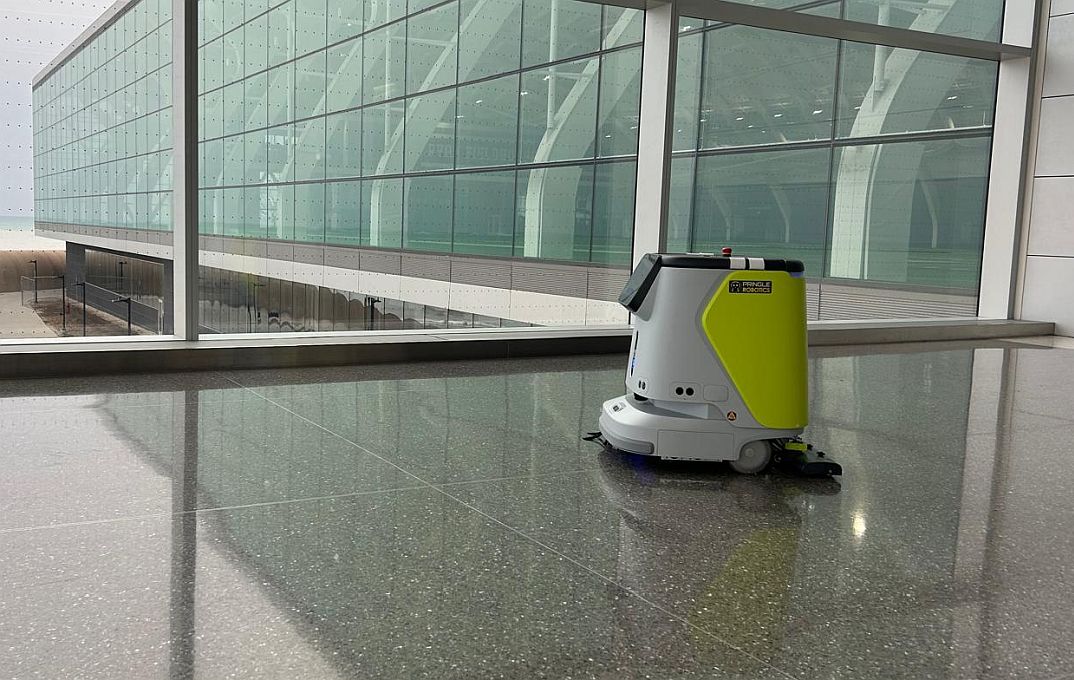
In a little over one year since Aramark announced a partnership with Pringle Robotics to install autonomous floor cleaning robots at strategic client facilities, a fleet of about 70 robots deployed at hospitals, schools, universities, businesses, and sports and entertainment facilities now cleans and maintains around 50 million square feet of space each year—roughly the size of 868 American football fields.
What is perhaps even more impressive is the way the partnership and technology have evolved to meet the needs of Aramark’s clients and their facilities.
“The efficiency, scalability, and customization have been a tremendous value to our teams and clients,” said Donald Pyles, Vice President of Program Development and Capability, Aramark Facilities Management. “I’m told we are the leader in our industry using robotics. Nobody else seems to be using them to the extent we do.”
Technology Advancements and Use-Case Evolution
Autonomous floor cleaning robots today use a synthesis of light detection and ranging (LiDAR), RGBD cameras, sonar, and simultaneous location and mapping (SLAM) algorithms to self-navigate and avoid obstacles.
Because no recording technology is involved, the robotic units are perfect for sensitive client areas.
Aramark began using Pringle Robotics’ model CC1 autonomous robot to vacuum carpets and clean hard floors. With its multi-surface cleaning capability, universal equipment and quick-change features, it quickly became ideal for many jobs.
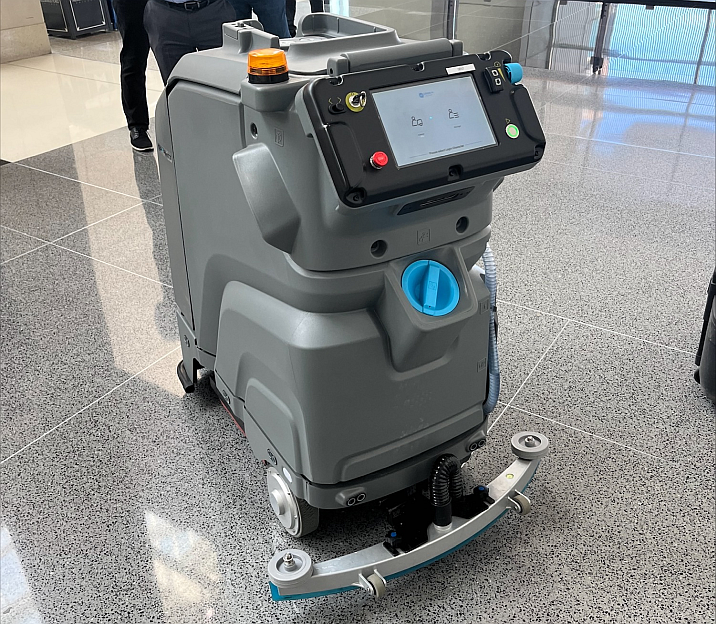
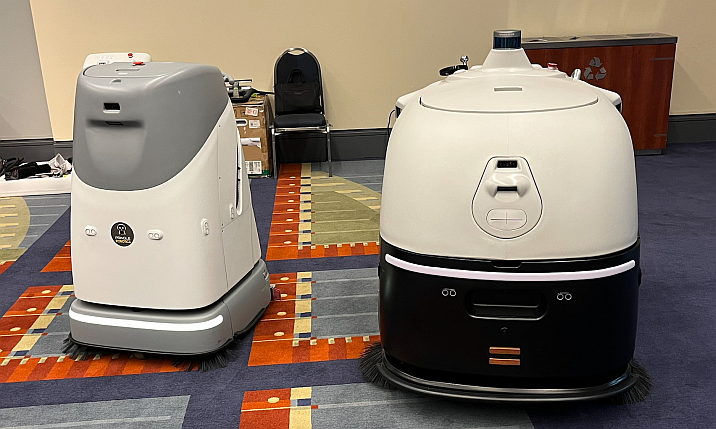
The team added CC3 units, which have a wider cleaning path for hard floors, and the CC5s, which can more quickly scrub larger areas. The recent addition of the AI-powered MT1 autonomous sweeper provides even more options for rapid floor cleaning with its visual debris recognition and powerful suction.
“The MT1 hard surface sweeper changed the ballgame for us,” said Michael Mollerdino, Director of Deployment and Business Optimization, Aramark Facilities Management. “With its lower profile and power, it can even sweep up a 20-ounce soda bottle. We keep learning of new applications and evolving the use based on our client locations and needs.”
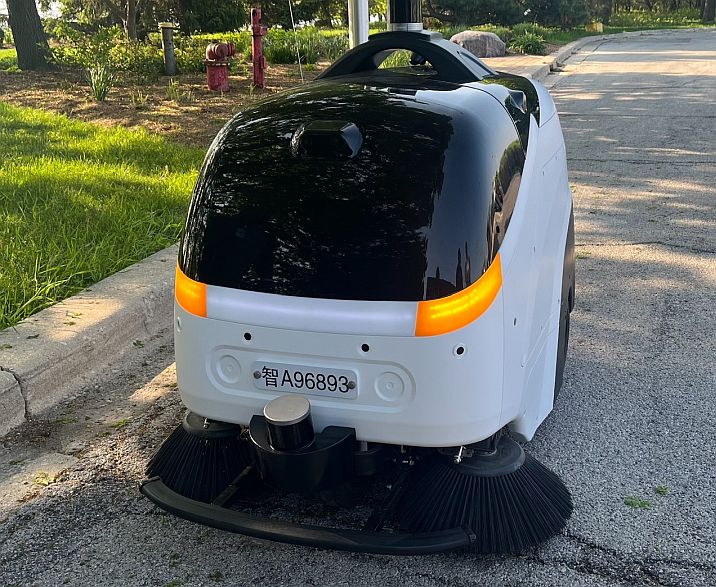
The even larger MT5 can work indoors and out. It is perfect for larger facilities where the Aramark teams must clean stadium concessions areas, sidewalks, parking garages, and other outside areas.
Some of the larger and newer robots are capable of cleaning almost 40,000 square feet an hour.
Collaborating on Solutions and Applications
The teams at Aramark work closely with Pringle Robotics to find new solutions to their real-world application and client needs.
For example, Aramark approached Pringle Robotics with a request for robotic equipment that can accept a 20-inch round pad for floor polishing and burnishing. Their engineers swiftly adapted the TN70 model to accept those pads.
“We have great working relationships with our vendor partners, including Pringle,” said Pyles. “It’s the ideal way to work together to ensure the design and technology fit the application—and we can build together for future uses.”
Together, the teams are testing robots that can call the elevator and proceed to other floors to continue cleaning—and other applications that, once finalized, will help perform a variety of tasks quickly and efficiently.
Enhancing Employee Pride and Safety
“Robots free up our people to perform more technical, critical cleaning procedures, such as cleaning patient rooms or public rest rooms,” said Mikki Kainz-Poplawski, Program Development and Training Director, Aramark Healthcare+. “The ‘bot managers’ in Healthcare+ are really proud to operate the units and learn a new technology that advances their skill set. It elevates not only our profession but the perception of clean.”
Operators program the robots to perform wherever and however they are needed. Once they are programmed, very little intervention is needed. The unit “learns” its program, sits in a docking station to charge and fill itself with water and cleaning products, and can even be programmed to turn itself on at certain times. Some units have “eyes” that light up when they’re “awake.”
Team member interactions are limited to periodic maintenance, such as rinsing filters and emptying the debris picked up by the units.
Aramark is also looking at robots that employ “follow me” technology to accompany team members with heavy equipment, such as linen carts, to reduce the risk of push/pull injuries.
“We are not eliminating labor. We are finding innovative ways to make jobs more efficient and safer,” said Kainz-Poplawski.
Optimizing Efficiency
Autonomous cleaning robots provide other efficiencies, as well, including water and energy savings.
“In a large office building, for instance, human cleaners need all the lights on. Robots can work in the dark if needed,” said Pyles. “We’ve come a long way already with our use and success with autonomous robots and we are constantly looking for new ways to manage facilities more efficiently and effectively.”

