The organization had done its homework. Before committing to a new workplace dining partner, the team toured best in class programs at Fortune 100 companies across the country. They walked campuses and evaluated how well run programs move people through a space, drive participation, and hold quality across multiple locations. One stop on that tour was a Workplace Hospitality account: a full campus dining experience with measurable participation rates, integrated digital ordering, and consistent quality across every location. The proof was already built in the field.
What the organization needed from a new partner was straightforward: better food, stronger branding, and a client relationship that worked. They were not unhappy with the staff or the guest experience under the previous provider. They were unhappy with the partnership and wanted a team that would show up as a consultant and collaborator.
The scope: multiple on campus dining and refreshment locations across 3,000 employees, and a transition timeline of ninety days. No disruption to the people who showed up for lunch every day, which started with the people already behind the counter.
The Ninety Days
The window opened when Workplace Hospitality was notified of the win and preparation began. It closed on opening day, ninety days later. Those ninety days were the work, structured in three phases: Partnership, Execution, and Launch.
Days 1 to 30 · Partnership
Align on strategy, embed in the account, design every decision with the client, and close down spaces on their timeline so execution can happen right.
Days 31 to 60 · Execution
Multiple vendors managed simultaneously. Full environmental redesign across every location: signage, lighting, tile work, cooler wraps, structural fixes, and a full menu and product refresh.
Days 61 to 90 · Launch
Open with the majority of existing staff retained and retrained. Drive pre launch digital adoption holding quality and consistency. Reach roughly a thousand team members per day at grand opening.
The Partnership phase set up everything that followed. The space closed one dining concept a full month before handover and another a week before. The team walked the spaces daily before opening day. Weekly joint design calls with the client ran through every decision.
What the Team Built
At the height of Execution, the team was managing multiple vendors at once: general contracting, internal paint and fixture operations, specialty fabrication, and environmental design. The work was not cosmetic. Structural fixes, removed grates, repositioned lighting, covered dust collectors, full cooler wraps throughout. Every dining and refreshment location was rebuilt end to end, with a full product reset and pantry conversions site wide.
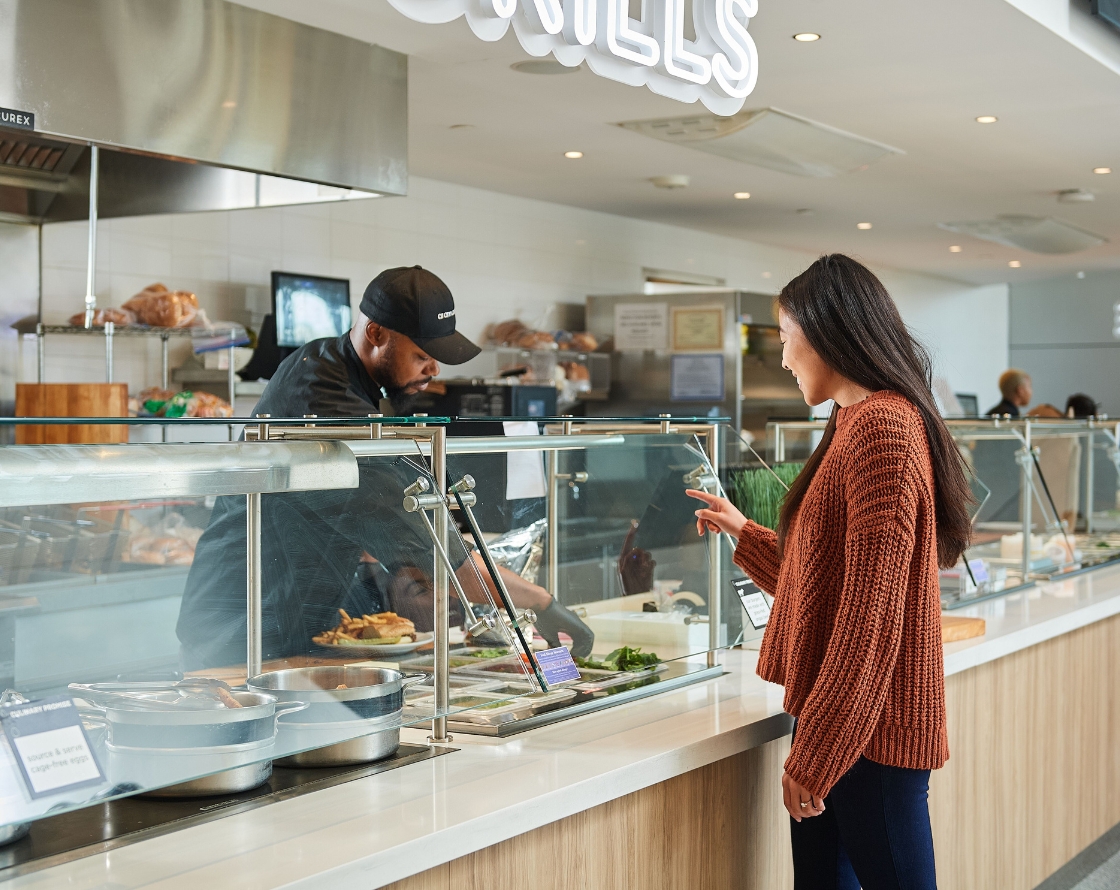
The client wanted authenticity, not approximation. Concepts were built to specification rather than to template: hand finished installations, live greenery, neon signage, and morning menus designed around real ingredients sourced to fit the concept. Rather than default to a national coffee brand, the team brought in an independent local roaster, who came on site ahead of launch to introduce themselves to employees before the doors opened.
The launch activation reached roughly a thousand team members per day at grand opening, with brand partners on site running giveaways and tabling events that turned opening week into a moment rather than a handover. Operations, marketing, and support teams were mobilized for the activation itself.
The majority of existing staff transitioned from the previous provider into the new program, including a meaningful portion of the management layer who carried over by choice. The continuity was essential to retain institutional knowledge alongside fresh perspective. When the doors reopened, employees were greeted by the same team members they already knew.
By the Numbers
- 1,000+ App Downloads in 17 days.
- 82% Staff retained from the previous provider into the new program at transition.
- ~1,000 Team members per day reached at grand opening across the campus.
- 36% Faster fulfillment by week three versus week one, while order volume rose week over week in the same period.
- 50% Mobile ordering adoption within the first ninety days.
The retention figure reflects a deliberate continuity strategy. When the doors reopened, employees were greeted by the same team members they already knew.
The app adoption numbers tell the operational discipline story as clearly as any other metric. By opening day, more than 1,000 employees on a 3,000-person campus had already downloaded the Servery app, driven by pre-launch tabling events, email campaigns, and vendor activations. By 90 days, 50% of users were on mobile ordering. The adoption was built into the Launch phase from the start, not added on.
Speed of service improved measurably as volume grew. At one food hall, average order fulfillment time dropped from 11 minutes 2 seconds in week one to 7 minutes 3 seconds by week three, a 36% improvement, while order volume increased 38% week-over-week in that same period. More guests, faster service, week on week.
Early guest feedback averaged 4 out of 5. Wait time and app usability are the friction points the next phase is built to close. The team knows where the gaps are, and the voice of customer data signals a strong brand foundation underneath them.
What Comes Next
The model is already informing portfolio strategy. The program built in ninety days becomes a portable playbook, applied and refined across additional sites in the relationship. Each new location is an opportunity to extend what was proven on a tight timeline.
Phase one was always the same: hold quality, keep service running, and earn the trust of the people already at the counter. That foundation is in place. The work now is growth.
Aramark Workplace Hospitality is built for a better workday.
Sign Up for News Alerts