.jpg)
When employees have 30 minutes to grab a meal, eat, and get back to the floor, a distant cafeteria does not work. For a large manufacturing operation running thousands of employees across multiple plants, that tension between the lunch window and meaningful food access was not a comfort issue. It was a productivity issue, a culture issue, and an operational gap that standard food service models had not closed.
Workplace Hospitality was brought in to consult on a solution that could feed employees quickly, reliably, and at scale, without requiring the capital investment or physical footprint of a traditional café buildout. The result was a mobile hot food trailer program, now operating across six locations with five additional trailers planned for expansion into Canada.
This program demonstrates what enterprise workplace dining looks like when it is built around operational constraints rather than ideal conditions. Speed, food quality, accessibility, and employee connection were not treated as competing priorities. They were engineered together.
Here is how the program came together, what it took to make it work, and what the results mean for organizations facing similar challenges.
The Standard Food Service Model Was Not Built for a 30-Minute Lunch Break
The operation is a large-scale manufacturing facility running approximately 1,500 employees daily across multiple plant floors, with additional floors opening by year's end that will bring on roughly 1,000 new employees. At that scale, food access is not a perk. It is an operational requirement, and the existing infrastructure was not keeping pace.
The core constraint was time. Employees in manufacturing environments often operate on lunch windows of 30 minutes. Within that window, an employee needs to travel from their workstation, obtain a real meal, eat, and return. A micromarket stocked with packaged goods addressed part of the need, but it did not answer the demand for hot, prepared food.
The existing micromarket program at these facilities provided a baseline level of food access. It was functional. It was not sufficient. Employees who wanted a hot meal had no path to one without leaving the building or waiting in a long line at a distant café. The practical result was that many employees skipped meals or settled for options that did not meet the need.
This is a gap that exists across manufacturing and industrial environments nationwide. The buildings are large, the workstations are distributed, and the lunch break is short. Cafeteria infrastructure built for a corporate office campus does not translate. Workplace Hospitality was tasked with designing a solution that did.
Designed a Mobile Hot Food Program Around the Plant Floor
The solution was a fleet of fully equipped food trailers positioned centrally within each plant. The trailers are steps away from workstations, not a building away. That proximity was not incidental. It was the operational logic the entire program was built on.
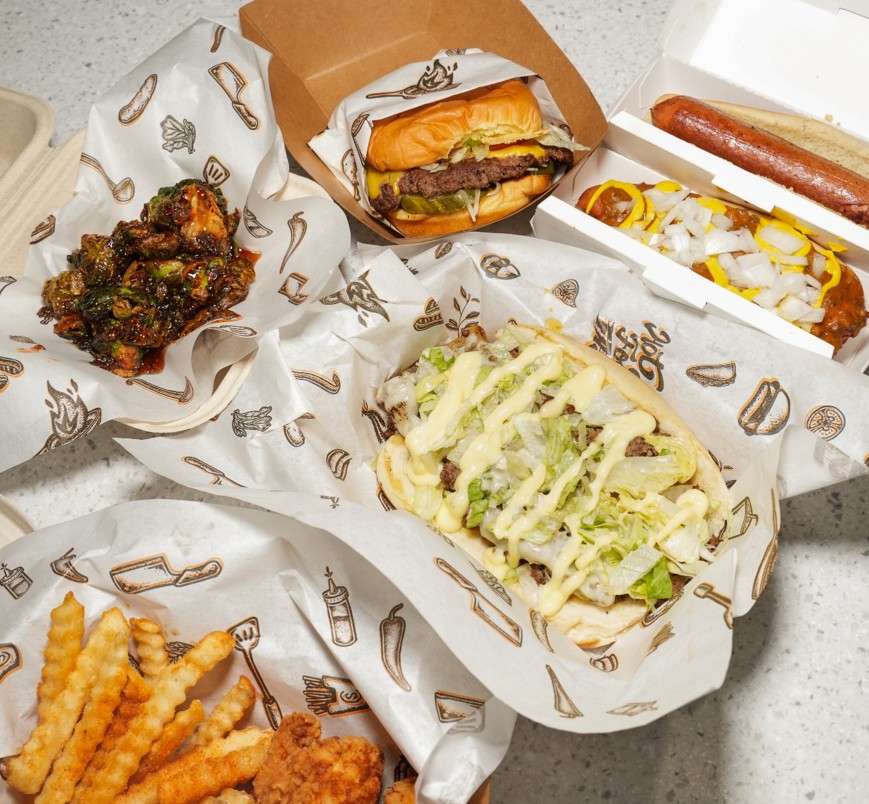
Each trailer is equipped with fryers and full hot food production capabilities. Menus are concise by design because the footprint of a trailer demands it. Limited storage and prep space require disciplined menu planning, and the culinary team treated that constraint as a design parameter rather than a limitation. Weekly rotating items, including burgers and handheld formats, deliver variety across the week without requiring a large daily menu to do it.
Menu development was data driven. The team analyzed transaction data from multiple manufacturing plant locations and reviewed backend platform data to identify top-selling items and the restaurant concepts with the strongest employee participation. The district chef worked directly with plant teams to translate that data into menus that could be executed at speed and at the volume these facilities require.
Food is delivered to employees in minutes. That is the operational standard the program was engineered to meet. The employees it serves noticed.
"I absolutely love our food truck. The staff is amazing. The accommodations and level of professionalism are impeccable. The fact that I don't have to leave the premises to eat is the best reward." — Manufacturing Plant Employee
Six Trailers Operating Across Multiple Plants
The program launched its first trailers in mid-2025 and has scaled to six operating locations, with an additional five trailers planned to launch in 2026, including expansion into Canada. The performance data across locations tells a consistent story.
At the first launch location, average daily transactions across the trailer reached 165 in the initial quarter after launch. By the following quarter, that figure climbed to 183 and has remained stable above 180 in subsequent periods. Participation rates held in the 11 to 12 percent range across the plant population.
At a second location launched in December 2025, the program generated 211 average daily transactions in its first month. By the first full quarter, that figure rose to 218.
Critically, the trailer program did not pull sales away from existing micromarket operations at these facilities. Micromarket transactions held steady. The trailers created an entirely new revenue stream, generating incremental volume rather than redistributing existing spend. For a program with a capital investment of approximately $200,000, that financial profile represents a compelling case for manufacturing and industrial operators who need to expand food access without committing to a full café buildout.
The Program Was Built for This Environment
The most important design decision in this program was also the simplest one. Workplace Hospitality did not take a cafeteria model and scale it down. The trailer program was designed from the beginning for the specific constraints of a manufacturing floor, a short lunch window, distributed workstations, and employees who need real food fast.
That specificity showed up in every operational decision. Trailer placement was determined by proximity to the highest concentration of workstations, not by what was convenient for logistics. Menu design was shaped by what employees at these specific plants actually buy, not by what a standard rotating contract menu offers. The launch was preceded by a tasting event the week before opening, allowing employees to provide feedback before the program went live and building anticipation before day one.
Marketing and communications reinforced the rollout at the plant level. Branded merchandise, coupons, digital screen announcements, and flyers distributed throughout the facilities ensured that employees at every corner of the building knew the program existed and understood how to use it.
The vision for this program was a long-term partnership, building on prior collaboration between Workplace Hospitality and the client from both an operational and design standpoint. Connection, the ability for employees to share a meal, have a conversation, and return to work ready, was the foundation the program was built to serve. The trailers made that possible within the lunch window that actually exists, not the one that would be convenient to design around.
Building Food Programs Around the Worksite
For manufacturing and industrial operators weighing how to expand food access without a full café investment, the mobile trailer model demonstrates what is possible when program design starts with the constraint rather than around it. Five principles define why this program worked.
1. Proximity is the product.
Placing trailers steps from work areas was the single most important operational decision. Access determines participation. Participation determines impact.
2. Data shapes the menu.
Menu development anchored in actual transaction behavior from comparable facilities produces menus employees use, not menus that look complete on paper.
3. Incrementality is the revenue story.
A well-placed trailer program adds new transactions. It does not cannibalize existing micromarket volume. The financial case depends on understanding that distinction.
4. Capital efficiency opens the door.
At approximately $200,000, the trailer model reaches locations where a café buildout is not viable. That is not a compromise. That is the appropriate solution for the environment.
5. Operational constraints are design parameters.
The best food programs in manufacturing environments are built around the realities of the floor, not imposed on top of them. Workplace Hospitality brings the capability to design accordingly.
Workplace Hospitality works with manufacturing, industrial, and enterprise operators to design dining programs that perform within the actual parameters of the worksite. If your operation has a food access gap that standard models have not closed, that is exactly the kind of challenge this team is built to solve.
Learn more today about the solutions we provide
Sign Up for News Alerts