
Building a social circle is critical to the higher education experience, especially for freshmen new to campus. Much of that bonding happens over shared meals and late-night snacks.
But for those with food allergies, this aspect of student life can be fraught with worry. There is no cure for food allergies, a potentially life-threatening condition that affects an estimated 32 million Americans. The only way to prevent an allergic reaction is to avoid the food in question.
“We’re actually seeing students and parents choosing their schools based on dining accommodations for food allergies,” shares Kelley Magowan, MS, RD, LDN, Senior Specialist, Health & Wellness. “It’s important for us to be able to provide safe food for them.”
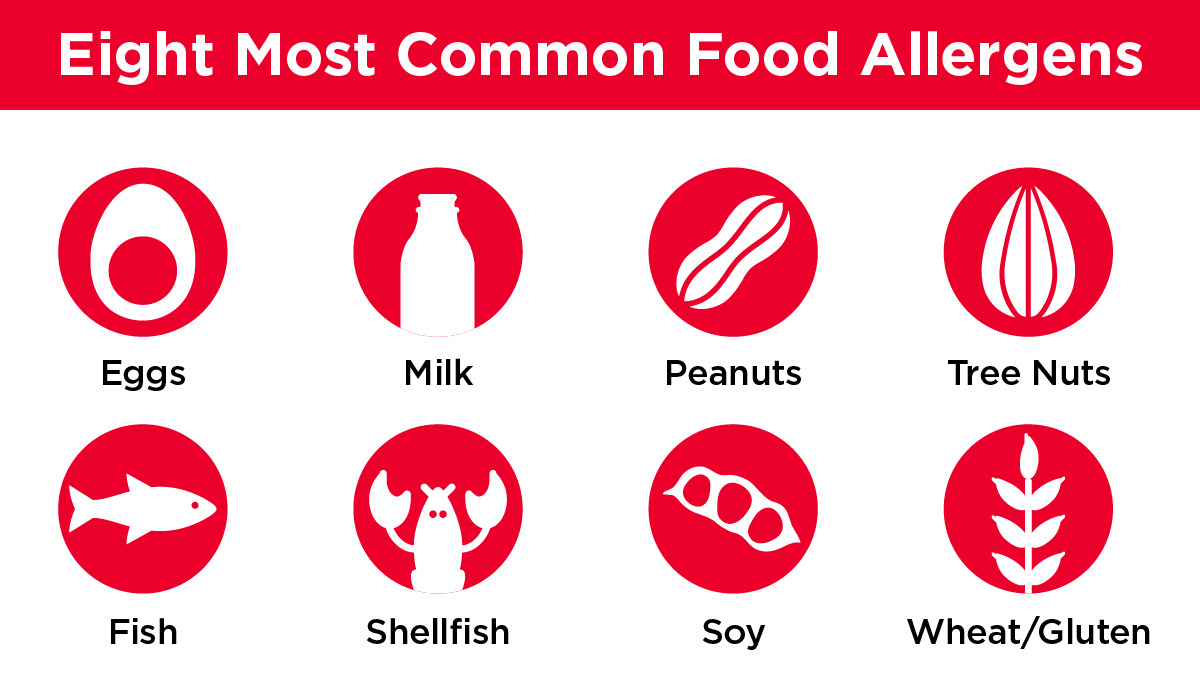
It’s been more than three years since we rolled out True Balance, our residential dining concept that features recipes developed without the most common food allergens, plus all sources of gluten. Since then, our cross-functional teams have been continuously building and expanding upon our allergen-friendly menus and safety protocols. Here’s a look at the role our allergen solutions play on campus, and what students can look forward to as they return for the fall 2021 semester.
All Eyes on Higher Ed
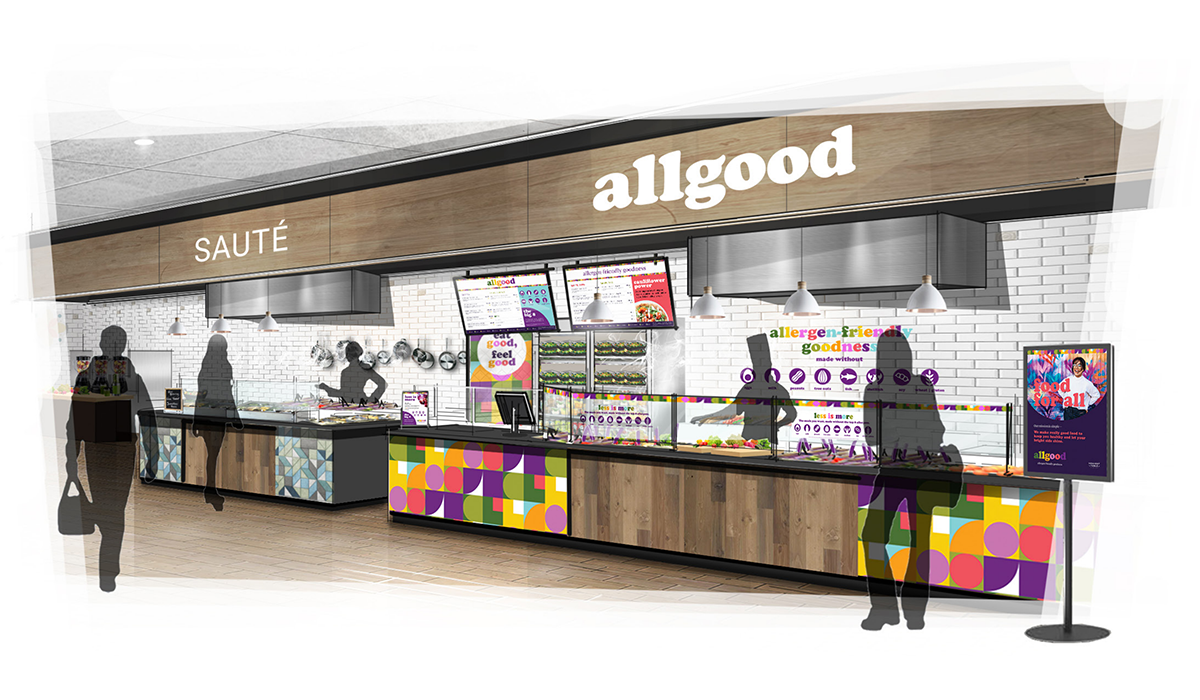
Colleges and universities were a natural place to launch an allergen-friendly dining concept. The number of American children with food allergies rose 50% between 1997 and 2011, according to the Centers for Disease Control and Prevention (CDC)—and eventually, those children head off to college. Away from parents’ watchful eyes, they must manage their food allergies on their own, some for the very first time. The same is also true for students with food intolerances, food sensitivities, and autoimmune conditions like celiac disease and Crohn’s. “These students are navigating new environments with a serious health condition. In many cases, they rely on campus dining for three meals a day, plus snacks,” Magowan says. “It’s on the school, and us as their dining partner, to safely provide all the food and nutrients they need.” With the right dining concept, institutions can help students with food restrictions stay healthy and happy. In addition to the True Balance station, our allergen solutions portfolio now includes Clean Plate, a retail platform that can blend in with any campus food court. We also recently introduced allgood, a premium concept for higher education and business dining, and we routinely solve for dietary restrictions in patient dining.
Want to see more like this?
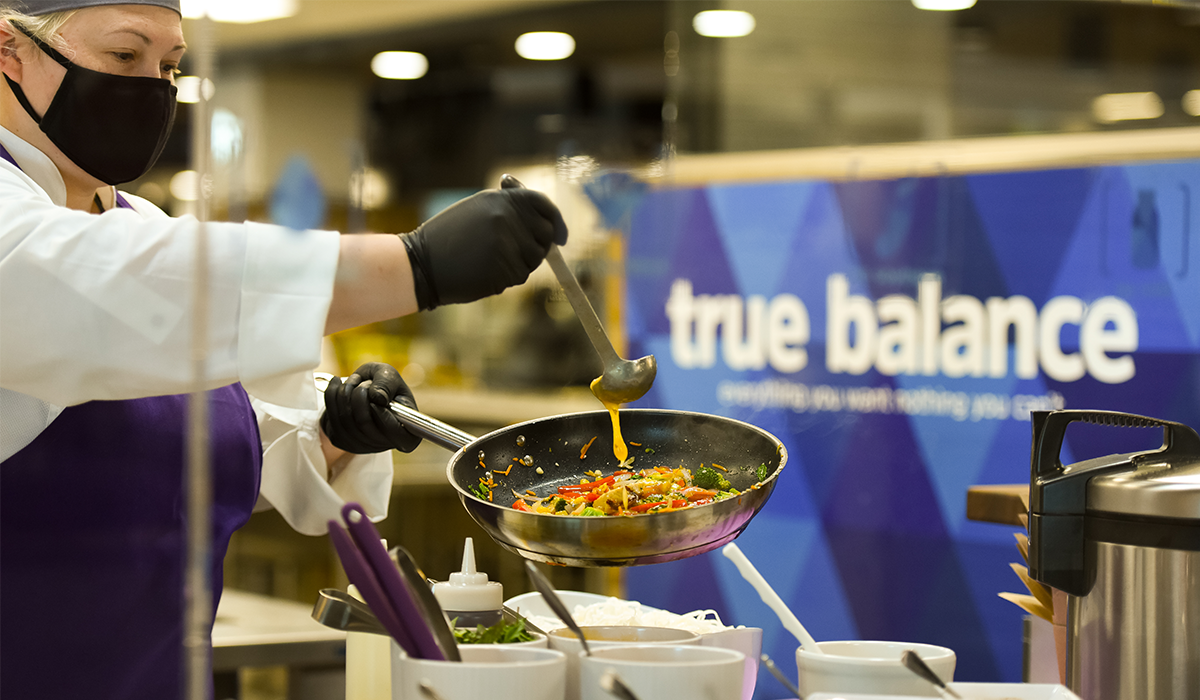
Prospective students and their families are often relieved to discover an allergen-friendly offering on campus—and that it is in the main residential dining room. That feeling of inclusion can help students with food allergies do well and even stay in school.
“Clients realize that dining is a big part of building community on campus, and they are increasingly aware of the needs of students with food allergies,” points out Michael Gilligan, Senior Director, Brand Development. “They turn to us as a partner who can help solve for that.” The demand is so high that large schools can support multiple allergen solutions outlets on the same campus. The University of South Carolina has opened both our retail and residential concepts on its main campus, which has an undergraduate student enrollment of about 27,000. And Arizona State University, with an enrollment of 44,000, has six dining stations dedicated to serving students with food allergies.
Meals with Wide Appeal
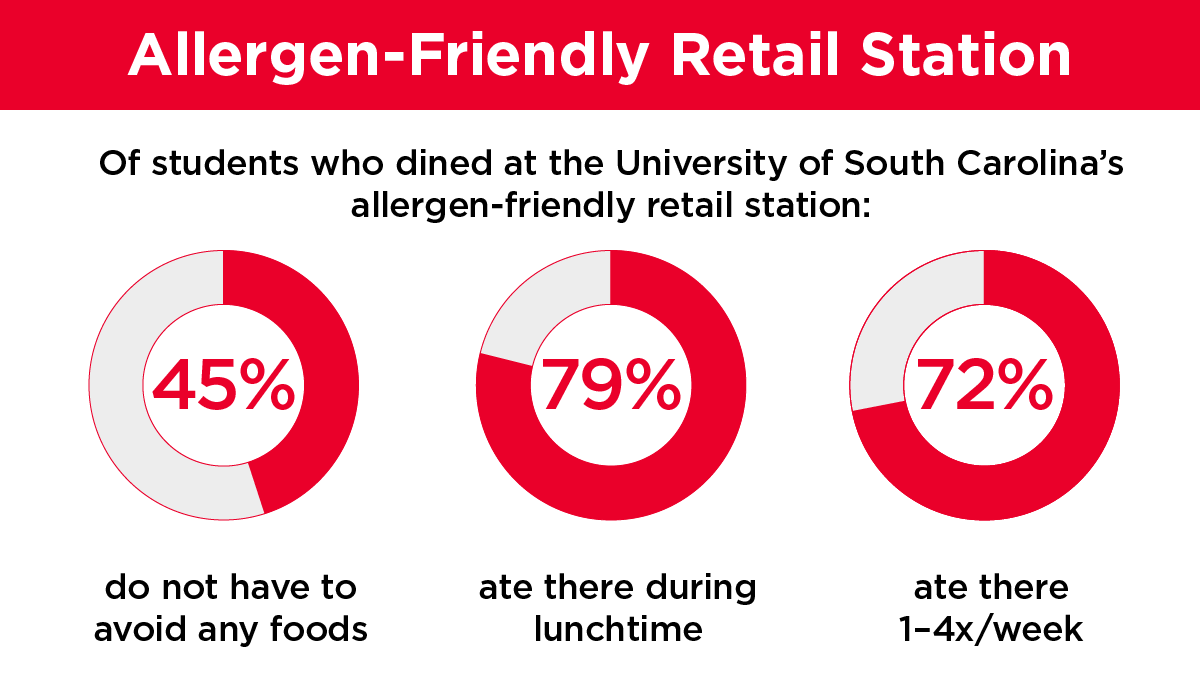
The ability to join roommates for dinner—and not have to go somewhere else or, worse, eat in their dorm room alone—can mean everything to an 18-year-old with a food allergy. But perhaps the greatest compliment comes when people who don’t have food restrictions choose to order from the same menu. That’s certainly the case at the University of South Carolina, as a Q1 2021 survey revealed that 45% of students who ate at their allergen-friendly retail station do not have to avoid any foods.
To date, we have opened 85 True Balance locations nationwide and, with the launch of Clean Plate and allgood, allergen-friendly solutions are growing more quickly than any other dining concept on campus. “The popularity of these concepts stems from their simple preparations and fresh, plant-forward ingredients,” Magowan notes. “Allergen-friendly concepts are not only for those with food allergies—they’re for anyone who wants delicious food.”
As Gilligan puts it: “The food may be made without common allergens, but it’s also just great food.”
Elevating the Experience
Even a trace of food allergen has the potential to cause a life-threatening reaction. With each True Balance, Clean Plate, and allgood operation, we devote rigorous attention to safety standards, tools, and procedures designed to prevent cross-contact. “Our guests’ safety is of paramount importance. We rely on every Aramark employee to maintain that integrity, on top of normal food safety standards,” Gilligan stresses.
Most recently, we partnered with MenuTrinfo to offer the gold standard in food allergy training for commercial kitchens. As we enter the 2021-22 school year, all food service managers overseeing a True Balance station will receive the American National Standards Institute (ANSI)-accredited AllerTrainTM eLearning courses, further enabling them to deliver safe food experiences for students with food allergies.
With the safety baseline well established, we have also tackled challenges people with food restrictions commonly face when eating out. For starters, we have expanded our plant-forward, vegetarian, and vegan menu offerings for those whose dining needs go beyond a food allergy or intolerance.
Students will also see a nod to ever-popular global cuisines on the menu. At Clean Plate, they can choose from signature food bowls evoking Mediterranean, Southwestern, and Asian flavor profiles—dispelling any misconception that allergen-friendly meals must be plain or boring. Or consumers can mix and match Clean Plate’s base ingredients (cilantro-lime brown rice, quinoa lentil blend, rice noodles, or kale) with various proteins, toppings, and sauces for seemingly endless combinations. That level of customization ranks high for Generation Z, who have grown up expecting personalization from their food experiences.
We’ve also expanded the allergen-friendly service styles to include made-to-order sauté, stir fry, pasta toss, and a taco bar. Starting this fall, we’ll add deep frying—something people with food allergies have learned to avoid for fear of cross-contact. When accounts opt to add a dedicated deep fryer, True Balance can turn out French fries, chicken tenders, and other campus favorites in an allergen-friendly setting. To help students start their day, we’ll also introduce enticing morning options from breakfast tacos to oat yogurt bowls, all prepared without the top eight allergens and gluten.
Next we are turning our attention to sesame, which was the subject of new U.S. food labeling legislation passed earlier this year. While regulations won’t take effect until January 2023, conversations have already started up and down our supply chain. “We’re working closely with our suppliers and manufacturers, planning to reevaluate every product and ingredient in our kitchens for sesame,” assures Gilligan.
A Collective Table
People with food allergies and related conditions will always need to take care when dining away from home. We’re earning student trust through thoughtfully prepared menus, well-trained staff, and transparent processes. “For somebody with a severe food allergy, it can be a matter of life or death,” says Magowan. “We’re proud to offer these dining concepts and execute them in a way that provides that level of safety.” New recipes roll out each semester, and we’re working day in and day out to improve our programs for students with food allergies. And if their friends enjoy eating there too? It’s icing on the proverbial (delicious, allergen-friendly) cake.

